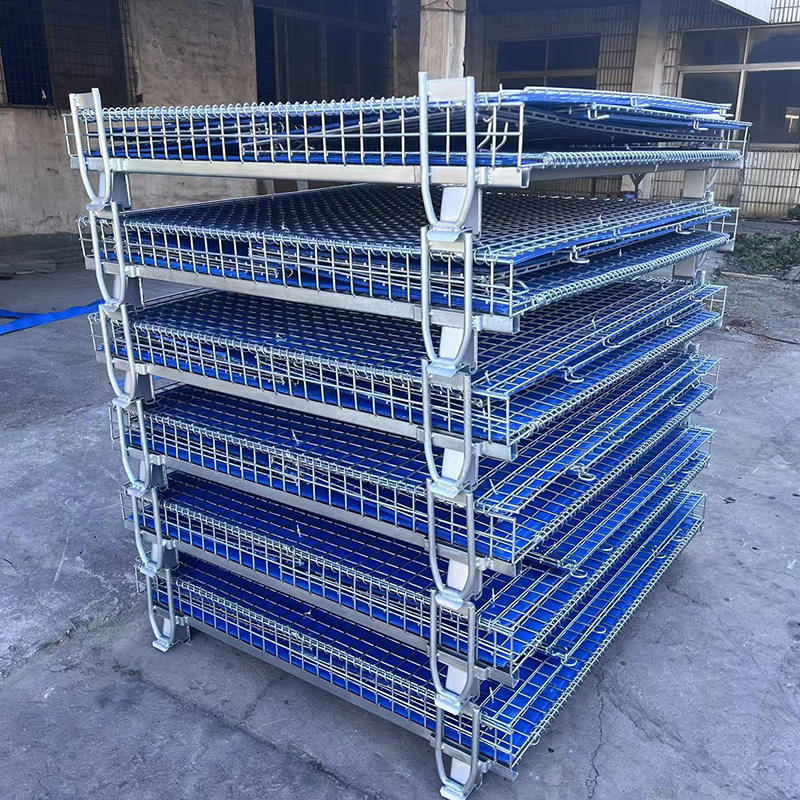
In the modern warehousing and logistics system, folding storage cages, with their core advantages of flexibility, convenience, and high space utilization, have become key equipment for enterprises to improve storage and turnover efficiency. This standardized metal container, with its scientific structural design, breaks through the limitations of traditional storage tools and is widely applicable to multiple scenarios such as material turnover in manufacturing, inventory management in retail, and warehousing and sorting in e-commerce.
The performance foundation of high-quality folding storage cages lies in their materials and craftsmanship. The main body is mostly made of Q235 high-line steel, forming a stable frame through precision welding. The mesh spacing is precisely controlled, which not only ensures a load-bearing capacity of 500-1500 kilograms but also clearly shows the status of internal goods. The surface galvanizing treatment endows it with excellent rust and corrosion resistance. In humid warehouses or outdoor turnover scenarios, its service life can be as long as 5-8 years, reducing equipment replacement costs.
The "folding" design is its core highlight in winning the market. In the empty cage state, it can be quickly folded to 1/4 of its original volume. Calculated based on standard warehouse space, an area that could originally only accommodate 20 fixed storage cages can store more than 80 after folding, and the space occupation cost during idle time is directly reduced by 75%. This feature is particularly crucial in phased warehousing needs such as e-commerce promotions, which can not only cope with peak inventory but also avoid space waste in the off-season.
Its value is further reflected in the efficiency improvement of the entire link: after loading goods, it can be directly stacked 3-4 layers by a forklift, reducing ground turnover links; after being delivered to the terminal, the side door opening design supports accurate picking without overall dumping; when empty cages are recycled, they are transported in a folded state, saving 70% of the return transportation capacity compared with traditional wooden boxes. Nowadays, intelligent models equipped with RFID tags have realized digital tracking of inventory, helping enterprises build an efficient warehousing system.