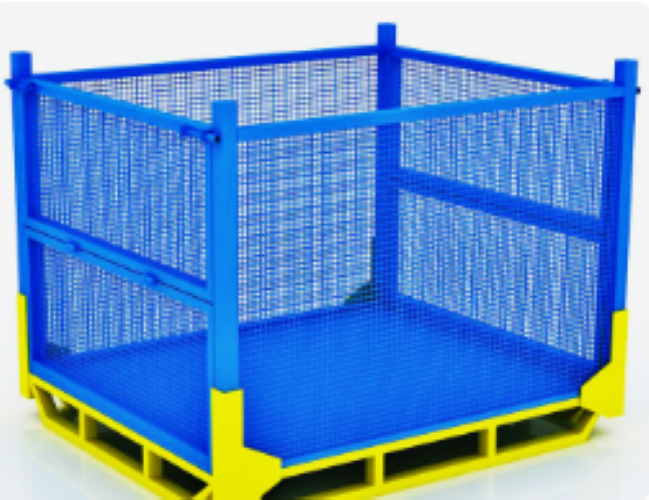
Recently, with the continuous development of industrial operations, foldable storage cages, as a highly efficient and practical storage tool, have become crucial. The proper selection of these cages is of great significance for enterprises' operational efficiency and cost control. Professionals have provided a detailed selection guide to help industrial enterprises better choose suitable foldable storage cages.
Foldable storage cages offer significant advantages such as space - saving, easy storage, and convenient transportation. When making a choice, the load - bearing capacity should be the first consideration. Different industrial scenarios have very different load - bearing requirements for storage cages. For example, the storage of heavy machinery parts requires storage cages with a high load - bearing capacity, while light plastic products have relatively lower load - bearing requirements. Enterprises need to accurately select storage cages with appropriate load - bearing capacities based on the actual weight and volume of the stored items to ensure safe and efficient use.
The material is also a non - negligible factor. Common materials for storage cages include steel and plastic. Steel storage cages are sturdy and durable, suitable for harsh industrial environments. Plastic storage cages are relatively lightweight and have a certain degree of corrosion resistance, making them suitable for industries with high hygiene requirements such as food and medicine.
In addition, the size and specifications of the storage cages should match the warehouse space and handling equipment. A reasonable size can make full use of the warehouse space, improve space utilization, and facilitate cooperation with handling equipment such as forklifts and pallets to enhance logistics turnover efficiency.
Professionals emphasize that choosing the right foldable storage cages is an important part of industrial operations. Enterprises should comprehensively consider multiple factors such as load - bearing capacity, material, and size to make a scientific and reasonable choice, thereby reducing operating costs, improving overall operating efficiency, and gaining an edge in the fierce market competition.